
Puppy Weight Chart by Age & Breed Size
See how big your puppy may get — and whether their growth is on track
Wondering how big your puppy will get — or whether their growth looks normal for their age?
These puppy weight charts help you estimate adult size, track weekly weight changes, and understand what’s typical for toy, small, medium, large, and giant breeds, based on real growth patterns rather than guesswork.

Content reviewed and updated for accuracy in 2026.
How Big Will My Puppy Get?
A puppy weight chart estimates how big your puppy may be as an adult by comparing their age and current weight to average growth patterns for their breed size. Because puppies grow at different rates, charts provide a realistic range rather than an exact prediction.
How to Use a Puppy Weight Chart (And What It Can Tell You)
Puppy weight charts are designed to help you track growth over time, not judge a single number in isolation. They’re especially useful for spotting trends — whether your puppy is gaining weight steadily, hitting a growth spurt, or slowing down as they mature.
One thing to know right away: there isn’t a single chart that works for every puppy. Growth rates vary depending on breed size, genetics, and age. That’s why puppy weight charts are broken down by breed size categories, rather than using a one-size-fits-all approach.
If you’ve ever caught yourself wondering “Is my puppy growing too fast?” or “How big will they actually get?” — you’re not alone. These charts are designed to give you realistic expectations, not exact predictions.
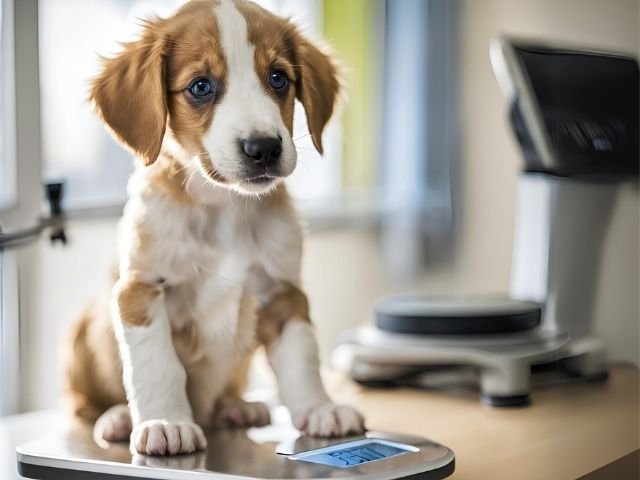
Puppy weight charts can help you:
- Estimate your puppy’s adult weight
- Track average weekly weight gain
- Compare growth to age-based milestones
- Spot potential growth issues early
When my dog Hudson was a puppy, his growth during the first six months felt almost alarming. Week after week, the numbers jumped. It turned out that what I was seeing was completely normal for German Shepherds — especially big, fast-growing pups. But at the time, I would have loved something reliable to compare against.
That’s exactly what these puppy weight charts are meant to be: a helpful reference, not a rigid rulebook.
Keep in mind that all charts are based on average growth patterns. Puppies don’t grow in straight lines — they have spurts and plateaus that don’t always match a neat graph. Small differences are normal, and as long as your puppy is happy, active, and healthy, there’s usually no need to worry.
In the sections below, you’ll find puppy weight charts organized by breed size, along with guidance on how to read them and what to expect at each stage of your puppy’s development.
Choose Your Puppy’s Size
Select the breed size below to jump straight to the right puppy weight chart.

Puppy Size Categories
Puppy growth timelines vary by breed size, and while every dog grows at their own pace, most puppies follow predictable patterns based on their adult size category.
The table below provides a quick reference for typical adult weight ranges and the age when puppies are usually considered fully grown. Keep in mind these are general guidelines — individual growth rates can vary based on genetics, nutrition, and overall health.
| Breed Size | Adult Weight Range | Full Grown By |
|---|---|---|
| Toy | Up to 12 lbs | 6–9 months |
| Small | 12–25 lbs | 8–12 months |
| Medium | 25–50 lbs | 12–15 months |
| Large | 50–100 lbs | 15–18 months |
| Giant | 100+ lbs | 18–36 months |
Below, you’ll find a closer look at each puppy size category, including growth pace, development milestones, and what to expect as your puppy matures.
What If You Have a Mixed-Breed Puppy?
If you have a mixed-breed puppy, figuring out which weight chart to use can involve a little more detective work — especially if you have no idea who Mom and Dad were!
If you know your puppy’s likely breed mix, use the expected adult size of those breeds as your starting point. If the parents were very different sizes, don’t expect your puppy to fit neatly into either breed’s growth pattern — the appropriate size category may fall somewhere between the two.
If you don’t know the breed mix, start with what you do know: your puppy’s age, current weight and general build. Compare those with the size categories above, then use the closest puppy weight chart as a rough guide rather than a prediction.
You can also try the puppy weight calculator below for another estimate. And if you’re really curious about what’s gone into your adorable mutt, a DNA test may help identify the breeds in the mix — although it still won’t predict their final weight with certainty.
Puppy Weight Calculator
If you’re looking for a quick estimate of how big your puppy might be when fully grown, you can also use our interactive puppy weight calculator.
Unlike simple calculators that treat every puppy the same, ours also takes expected adult size into account. Choose toy, small, medium, large or giant, and the estimate adjusts for the different ages at which dogs of different sizes typically mature.
It’s a helpful option if you want a fast answer — and a good complement to the weight charts below, which show average growth milestones over time.
Results are rough estimates rather than exact predictions. Every puppy grows at their own pace.
Track Your Puppy's Growth
Want to keep an eye on your puppy’s progress? Download this free printable Puppy Weight Tracker and record their weight as they grow.
Toy Breeds Puppy Weight Chart
Toy breed puppies grow quickly — often much faster than people expect. Because they’re so small, even what looks like a tiny change on the scales can represent a noticeable step in their growth.
Most toy breeds reach their adult size earlier than larger dogs, typically at around 6–9 months, although individual puppies don’t all follow exactly the same timetable.
Quick Facts
Toy breeds typically reach full size at:
➡️ 6–9 months for most toy breeds
➡️ Individual puppies may mature a little earlier or later
➡️ Toy breeds generally weigh: up to around 12 pounds when fully grown
Toy breeds include (but aren’t limited to):
Chihuahua, Chinese Crested, Maltese, Papillon, Pekingese, Pomeranian, and Yorkshire Terrier.
How to use the toy breed chart
Start with your puppy’s age down the left side, then find the closest current weight. Follow that column down to see a rough idea of:
-
what your puppy may weigh at key milestones, and
-
what their adult weight may look like when fully grown.
If your puppy’s weight falls between two numbers on the chart, don’t stress — just use the closest range (or take the average) to get a more realistic estimate.
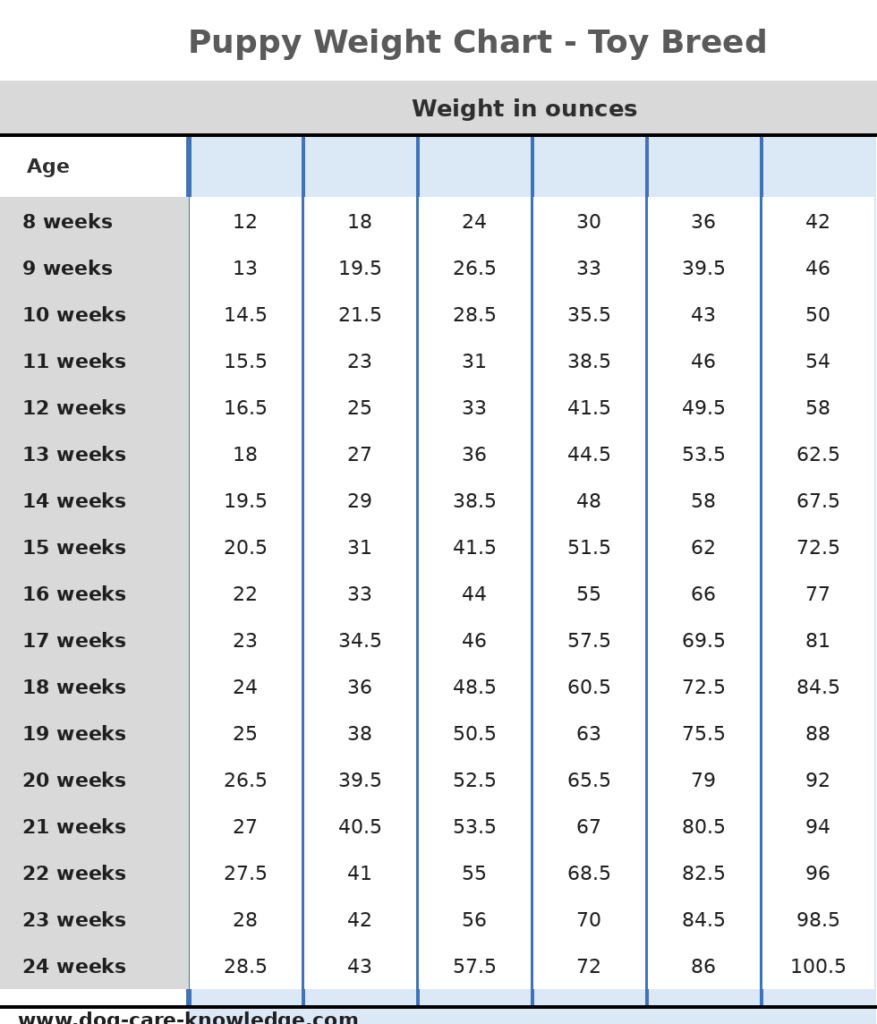
Scroll horizontally to see all columns on mobile
Remember: these are averages. A small difference doesn’t automatically mean something is wrong — puppies grow in little spurts.
Conversion
- 1 lb = 16 oz
- 1 oz = 28.35 g
Pounds (lb): 0
Kilograms (kg): 0
Small Breeds Puppy Weight Chart
Small breed puppies grow steadily, but not quite as fast as toy breeds. They typically gain weight at a consistent pace during early puppyhood, then begin to slow as they approach maturity.
Most small breeds reach their adult weight between 8 and 12 months, although some may continue filling out slightly beyond their first year.
Quick Facts
Small breeds reach adult weight at:
➡️ 8–12 months for most small breeds
➡️ Individual puppies may mature a little earlier or later
➡️ Small breeds generally weigh: 12 to 25 pounds when fully grown
Small breeds include (but aren’t limited to):
Cavalier King Charles Spaniel, French Bulldog, Jack Russell Terrier, Pug, Miniature Schnauzer, Boston Terrier, and Dachshund.
How to use the small breed chart
Start with your puppy’s age down the left side, then find the closest current weight. Follow that column down to see a rough idea of:
-
what your puppy may weigh at key milestones, and
-
what their adult weight may look like when fully grown.
If your puppy’s weight falls between two numbers on the chart, don’t stress — just use the closest range (or take the average) to get a more realistic estimate.
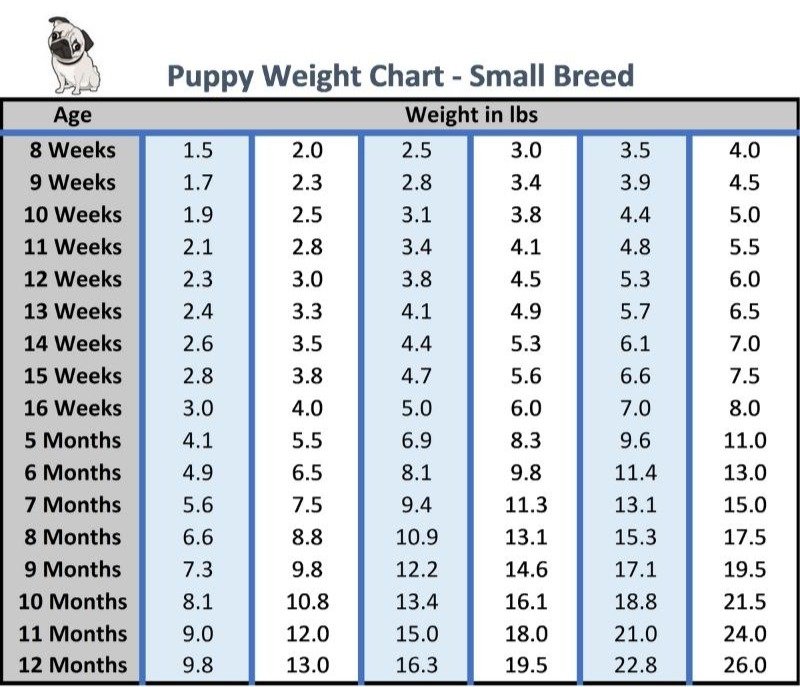
Scroll horizontally to see all columns on mobile
Remember: these are averages. A small difference doesn’t automatically mean something is wrong — puppies grow in little spurts.
Medium Breeds Puppy Weight Chart
Medium breed puppies tend to grow at a more balanced pace than smaller dogs. They don’t mature as quickly as toy or small breeds, but they also don’t take as long as large breeds to reach their adult size.
Most medium breeds continue growing steadily throughout their first year and typically reach their adult weight between 12 and 15 months.
Quick Facts
Medium breeds reach adult weight at:
➡️ 12–15 months for most medium breeds
➡️ Individual puppies may mature a little earlier or later
➡️ Medium breeds generally weigh: 25 to 50 pounds when fully grown
Medium breeds include (but aren’t limited to):
Border Collie, Bulldog, Beagle, Cocker Spaniel, Standard Schnauzer, and Whippet.
How to use the medium breed chart
Start with your puppy’s age down the left side, then find the closest current weight. Follow that column down to see a rough idea of:
-
what your puppy may weigh at key milestones, and
-
what their adult weight may look like when fully grown.
If your puppy’s weight falls between two numbers on the chart, don’t stress — just use the closest range (or take the average) to get a more realistic estimate.
Tip: Medium breeds often go through noticeable growth spurts. A brief plateau followed by a sudden increase is usually normal.
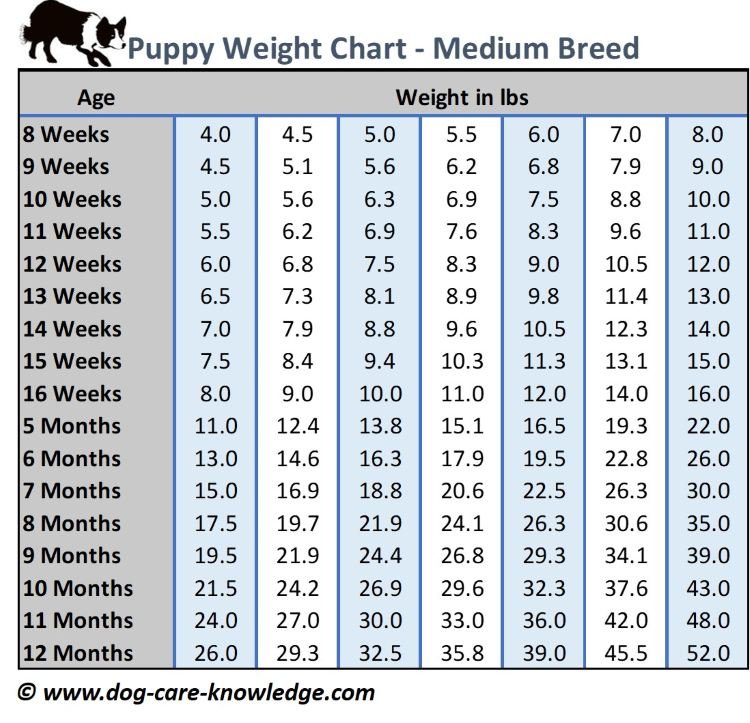
Scroll horizontally to see all columns on mobile
Remember: these are averages. A small difference doesn’t automatically mean something is wrong — puppies grow in little spurts.
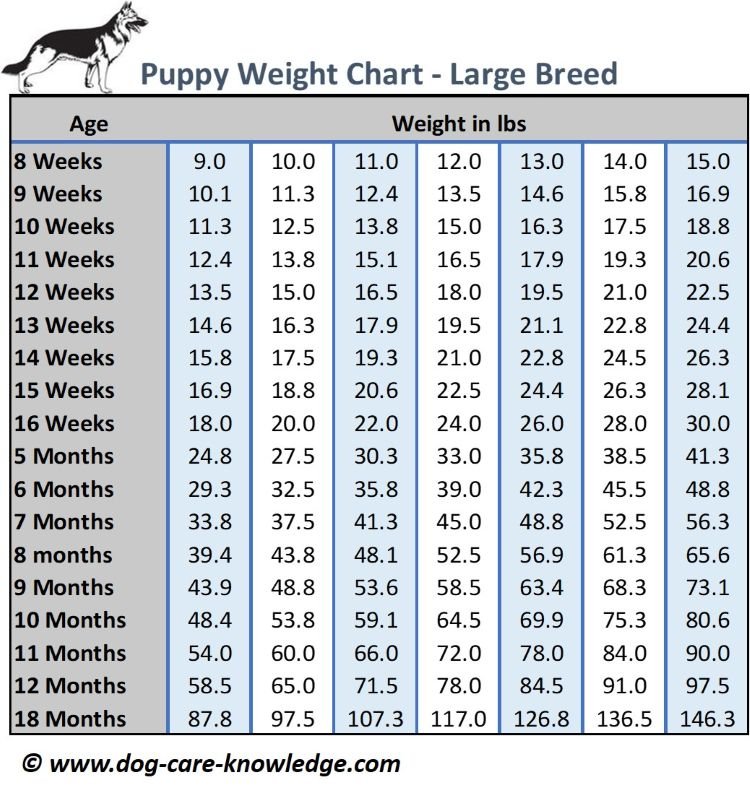
Large Breeds Puppy Weight Chart
Large breed puppies grow over a much longer period than smaller dogs, and their growth is often less even. It’s common for large puppies to go through noticeable spurts followed by slower phases as their bodies adjust.
Most large breeds continue growing well beyond their first year and usually reach their adult weight between 15 and 18 months, with some still filling out after that.
Quick Facts
Large breeds reach adult weight at:
➡️ 15–18 months for most large breeds
➡️ Some may continue filling out beyond 18 months
➡️ Large breeds generally weigh: 50 to 100 pounds when fully grown
Large breeds include (but aren’t limited to):
Labrador Retriever, Golden Retriever, German Shepherd, Boxer, Doberman Pinscher, Rottweiler, and Belgian Malinois.
How to use the large breed chart
Start with your puppy’s age down the left side, then find the closest current weight. Follow that column down to see a rough idea of:
-
what your puppy may weigh at key growth milestones, and
-
what their adult weight may look like when fully grown.
If your puppy’s weight jumps quickly or seems to stall for a while, don’t panic — uneven growth is very common in large breeds.
Tip: For large puppies, steady growth is more important than rapid growth. Sudden changes don’t automatically indicate a problem, but dramatic or ongoing shifts are worth discussing with your vet.
Scroll horizontally to see all columns on mobile
Remember: these are averages. A small difference doesn’t automatically mean something is wrong — puppies grow in little spurts.
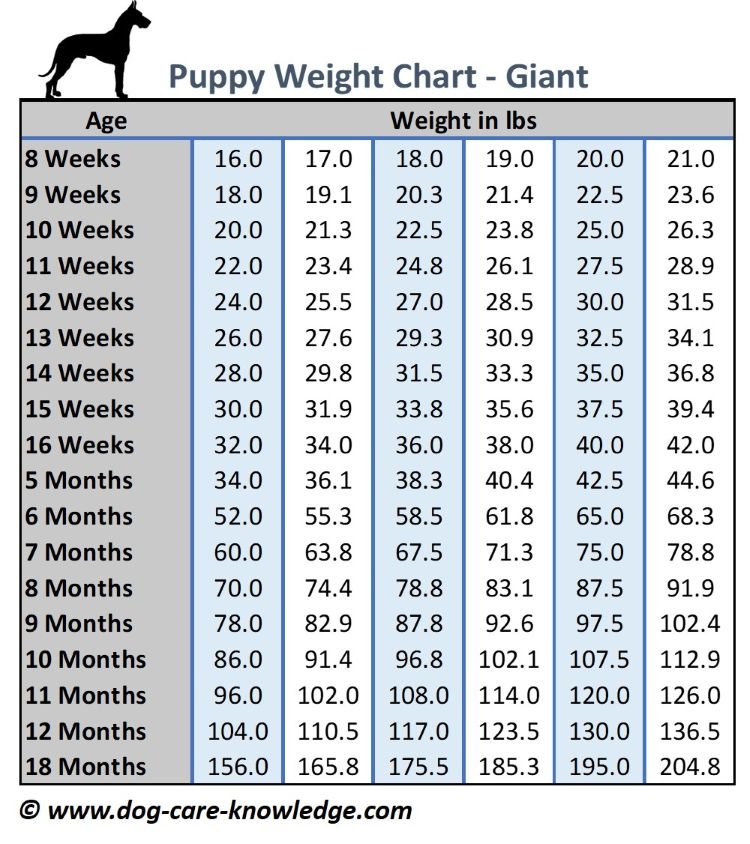
Giant Breeds Puppy Weight Chart
Giant breed puppies grow over a much longer period than all other dogs, and their growth can look surprisingly slow at times. These puppies don’t just grow bigger — they grow for longer — which often catches owners off guard.
Most giant breeds continue growing well past their first year and usually don’t reach their full adult size until 18 to 24 months, with some still maturing for up to 3 years.
Quick Facts
Giant breeds reach adult weight at:
➡️ 18–24 months old for most giant breeds
➡️ Up to 2–3 years for the largest or slowest-maturing dogs
➡️ Giant breeds generally weigh: Over 100 pounds when fully grown
Giant breeds include (but aren’t limited to):
Great Dane, Saint Bernard, Mastiff, Newfoundland, Irish Wolfhound, and Leonberger.
How to use the giant breed chart
Start with your puppy’s age down the left side, then find the closest current weight. Follow that column down to see a rough idea of:
what your puppy may weigh at key growth milestones, and
what their adult weight may look like when fully grown.
Because giant breeds mature so slowly, it’s normal for their growth to appear uneven or to plateau for extended periods.
Tip: A giant breed puppy that looks “behind” on the chart is often still completely on track. Slow, steady development is typical for dogs of this size.
Scroll horizontally to see all columns on mobile
Remember: these are averages. A small difference doesn’t automatically mean something is wrong — puppies grow in little spurts.
Puppy Weight Chart FAQs
How accurate are puppy weight charts?
Puppy weight charts are best used as a general guide, not a guarantee. They’re based on average growth patterns for a breed size, so they can give you a realistic range — but individual puppies may grow faster or slower depending on genetics, nutrition, and activity.
Can I predict my puppy’s adult weight at 8 weeks?
You can get an early estimate, but it’s usually less reliable at very young ages. The most helpful approach is to compare your puppy’s weight over time (week to week) and use the chart as a trend line rather than a one-time prediction.
What if my puppy is above or below the chart?
Small differences are common — puppies grow in spurts and can plateau for a bit. If your puppy is consistently far above or below the expected range over several weeks, or you notice changes in energy, appetite, or overall condition, it’s a good idea to check in with your vet.
Do mixed breed puppies follow the same growth patterns?
Mixed breed puppies can be trickier because their adult size depends on their genetic mix. A good starting point is to choose the chart that matches their current build and expected size, and compare adjacent sizes if they seem between categories.
When do puppies stop growing?
It depends on breed size. Toy breeds often finish earlier (around 6–9 months), while large breeds commonly grow until 15–18 months, and giant breeds may continue maturing until 18–24 months (sometimes longer).