
Puppy Weight Calculator by Age & Breed Size
Estimate how big your puppy may get — using real growth patterns
Curious how big your puppy might be when fully grown?
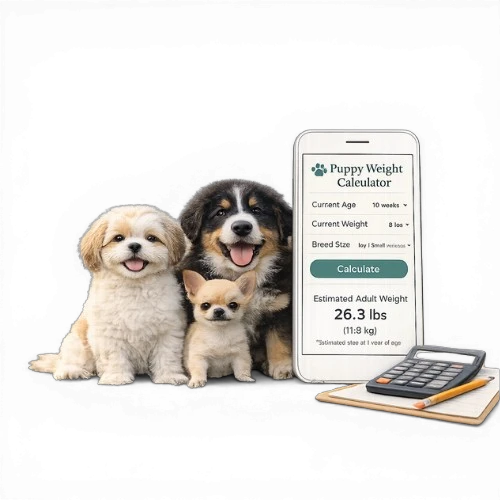
This interactive puppy weight calculator estimates adult size based on your puppy’s current age, weight, and expected breed size — helping you understand what’s typical as they grow.
How Accurate Is a Puppy Weight Calculator?
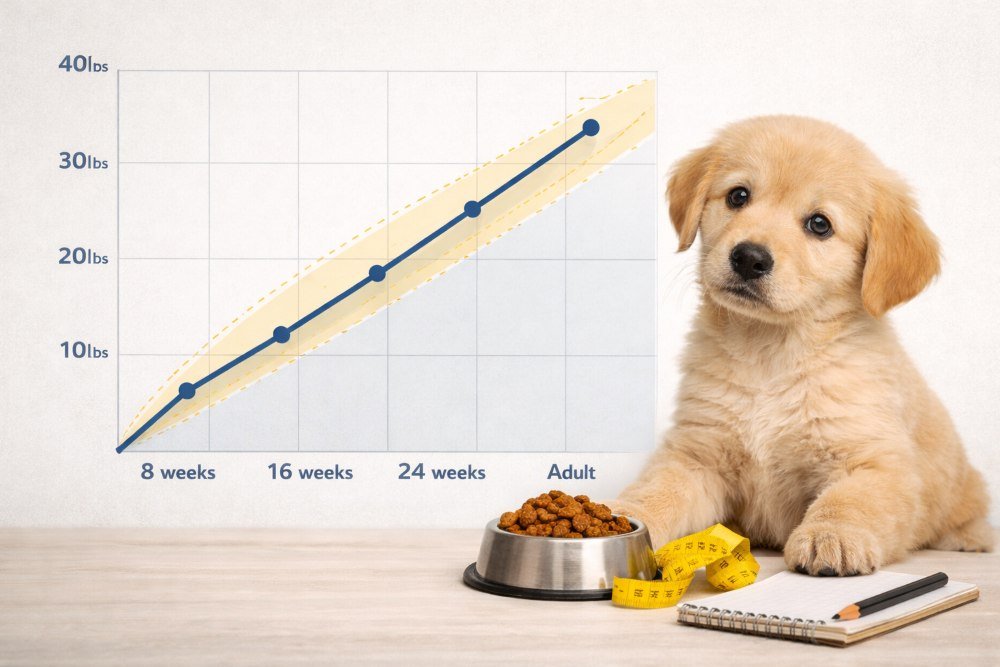
A puppy weight calculator can give you a useful estimate of how big your puppy may be as an adult, but it’s important to understand what those results represent.
This calculator works by comparing your puppy’s current age, weight, and expected breed size to average growth patterns seen in dogs of similar sizes. The result is a realistic range, not an exact prediction.
Puppies don’t all grow at the same pace. Genetics, nutrition, activity level, and even timing of growth spurts can all affect how quickly weight is gained. That’s why your puppy’s estimated adult weight may change slightly as they grow — and that’s completely normal.
Think of this tool as a guide, not a guarantee. It’s designed to help you understand what’s typical, spot trends over time, and feel more confident about your puppy’s growth.
Use the Puppy Weight Calculator Below
Using the calculator is quick and simple. Just enter your puppy’s current age, current weight, and expected breed size to get an estimated adult weight based on typical growth patterns.
If you’re not sure which breed size category your puppy fits into — especially for mixed breeds — don’t worry. You can use your puppy’s current size as a guide, or compare results with nearby categories for a more complete picture.
For best results, update your puppy’s weight regularly and focus on the trend over time rather than a single number.
You’ll find additional explanations and example calculations further down the page.
Puppy Weight Calculator
Puppy Weight Calculator
How the Puppy Weight Calculator Works
Like most puppy weight calculators you’ll find online, this one gives you a rough estimate of your puppy’s adult weight based on the information you know now. No calculator can predict a puppy’s final weight with complete accuracy — there are simply too many individual differences involved.
What makes this calculator a little different is that it also takes your puppy’s expected breed size into account. Instead of treating every puppy as though they grow and mature at the same rate, you choose whether your puppy is expected to be toy, small, medium, large or giant.
That matters because a tiny toy breed and a Great Dane don’t follow the same timetable. Smaller dogs generally reach their adult size much sooner, while large and giant breeds can continue growing for considerably longer.
So, just like other online puppy weight calculators, the result should be treated as a ballpark estimate rather than a guarantee — but the breed-size setting gives the calculation another useful piece of information to work with.
The basic idea behind the calculation
The calculator starts with your puppy’s current weight and age in weeks, then factors in the expected maturity age for the breed-size category you selected.
For example, a toy puppy is expected to reach adult size much sooner than a large or giant puppy. The calculator takes that difference into account when estimating how much growing your puppy may still have left to do.
If your puppy has already reached the typical maturity age for their selected size category, the calculator uses their current weight as the rough adult-weight estimate rather than assuming they will continue growing at the same rate.
The important thing to remember is that this is still an estimate. Puppy growth isn’t perfectly linear, so the calculation can’t account for every growth spurt, plateau, genetic difference or individual variation.
Why results can change as your puppy grows
Puppies don’t gain weight at a perfectly steady pace. They have growth spurts, slower periods and the occasional plateau — all perfectly capable of making last month’s estimate look a little different from this month’s.
That’s why it’s useful to weigh your puppy regularly and look at their overall growth trend, rather than getting too attached to one predicted number.
A quick reminder about estimates
Your puppy is an individual, not a mathematical formula. Genetics, breed mix, nutrition, body condition and individual growth rate can all influence their eventual adult size.
Use the calculator as a handy starting point, then compare the result with the puppy weight charts on this website. If you’re concerned about how quickly your puppy is gaining or losing weight, or about their body condition, speak to your veterinarian.
Breed Size Categories Explained
Puppy growth varies widely depending on breed size, which is why this calculator uses size categories rather than a one-size-fits-all formula.
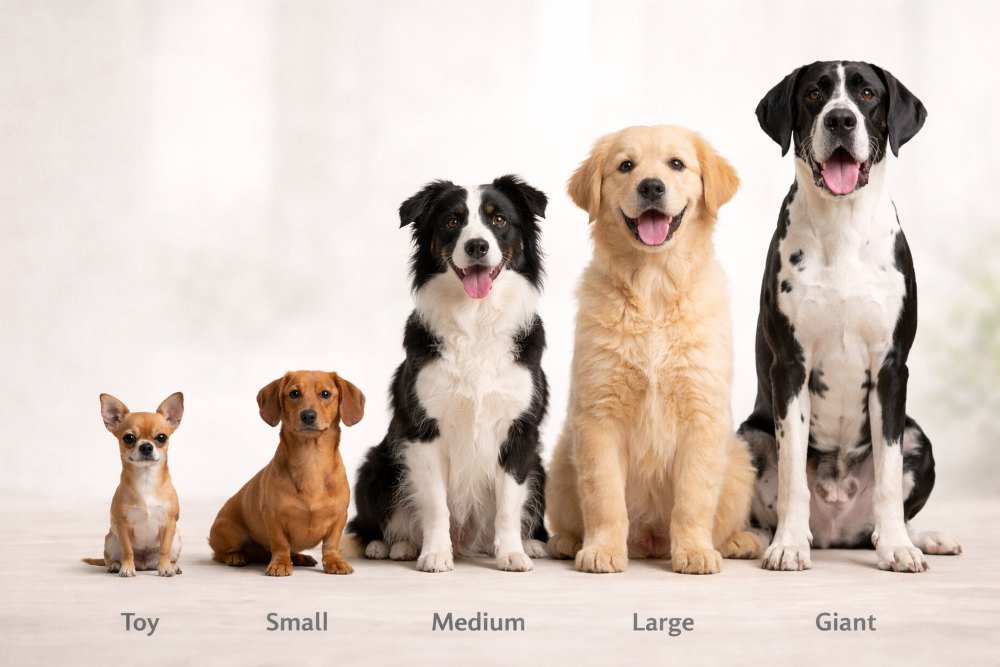
Most dogs fall into one of five general size groups based on their expected adult weight. These categories help set realistic expectations for how quickly puppies gain weight and how long they continue growing.
| Breed Size | Adult Weight Range | Full Grown By |
|---|---|---|
| Toy | Up to 12 lbs | 6–9 months |
| Small | 12–25 lbs | 8–12 months |
| Medium | 25–50 lbs | 12–15 months |
| Large | 50–100 lbs | 15–18 months |
| Giant | 100+ lbs | 18–36 months |
These ranges reflect average growth patterns, not strict limits. Some puppies may mature slightly earlier or later depending on genetics and overall development.
What if my puppy falls between two sizes?
This is especially common with mixed-breed puppies or breeds near the upper or lower end of a size range.
If you’re unsure:
choose the size category that best matches your puppy’s current build, or
run the calculator using two nearby sizes and compare the results.
In most cases, the true adult weight will fall somewhere between those estimates.
Why breed size matters so much
Smaller puppies tend to grow quickly and finish earlier, while larger and giant breeds grow more slowly and continue developing for much longer. Using the correct size category helps the calculator adjust expectations so results feel realistic — not alarming or misleading.
If you’d like a visual comparison of how puppies grow at different sizes, you can also explore our puppy weight charts by age and breed size.
Puppy Weight Estimation Formulas (Optional)
If you like to understand how puppy weight calculators arrive at their estimates — or you want to double-check results yourself — these commonly used formulas can help.
None of these methods are exact. They’re best used as rough guides, especially when combined with puppy weight charts and trends over time.
Toy Breeds — The Doubling Method
Toy breed puppies grow very quickly during the first few weeks of life, which makes simple doubling formulas surprisingly effective early on.
How it works:
Take your puppy’s weight at 6 weeks
Double it
Then double it again
Example:
Weight at 6 weeks: 2 lbs
Double once: 2 × 2 = 4 lbs
Double again: 4 × 2 = 8 lbs
Estimated adult weight: ~8 lbs
This method works best for very small toy breeds and is less reliable once puppies are older.
Small Breeds — Growth Rate Formula
For small breed puppies, a weekly growth-rate approach can provide a reasonable estimate.
The formula:
Growth rate = current weight ÷ age in weeks
Once you have the growth rate, multiply it by 52 weeks.
Example:
Current weight: 4 lbs
Age: 14 weeks
Growth rate: 4 ÷ 14 = 0.29 lbs/week
Adult estimate: 0.29 × 52 = 15.08 lbs
This method works best when your puppy is past the very early growth stage.
Medium Breeds — The 14-Week Method
Medium breed puppies often follow a steadier growth curve during early development.
How it works:
Take your puppy’s weight at 14 weeks
Double it
Add half of the 14-week weight
Example:
Weight at 14 weeks: 10 lbs
Double: 10 × 2 = 20 lbs
Add half: 20 + (10 ÷ 2) = 25 lbs
Estimated adult weight: ~25 lbs
This method provides a mid-range estimate and works best for puppies with consistent early growth.
Large & Giant Breeds — Growth Rate Method (20 Weeks)
Large and giant breed puppies grow over a much longer period, which makes early formulas less accurate. For these dogs, calculations work best once puppies are older.
How it works:
Use your puppy’s weight at 20 weeks
Divide by age in weeks to get the growth rate
Multiply by 52 weeks
Example:
Current weight: 45 lbs
Age: 20 weeks
Growth rate: 45 ÷ 20 = 2.25 lbs/week
Adult estimate: 2.25 × 52 = 117 lbs
This approach works best once growth has slowed slightly.
Large & Giant Breeds — 6-Month Doubling Method
Another simple method for large and giant breeds is to double the puppy’s weight at 6 months.
Example:
Weight at 6 months: 39 lbs
Double: 39 × 2 = 78 lbs
This method often produces a conservative estimate, especially for very large dogs that continue filling out well past their first year.
These formulas are helpful reference tools, but they don’t replace tracking trends over time. Growth charts and regular vet check-ups provide the most complete picture.

Other Factors That Affect Puppy Growth
Even the best puppy weight calculator or chart can’t account for every variable. Puppies grow at different rates — sometimes even within the same litter — and several factors can influence how quickly (or slowly) they gain weight.
Understanding these influences can help you interpret your results more realistically and know when a small variation is completely normal.
Genetics
Genetics play the biggest role in determining your puppy’s final size. Puppies tend to follow growth patterns similar to their parents, including overall build and adult weight.
If your puppy came from a breeder, learning about the size of the parents and previous litters can offer valuable insight. For mixed-breed puppies, growth can be less predictable, especially if parents were very different sizes.
Nutrition
Puppies have specific nutritional needs to support healthy growth. A balanced, age-appropriate puppy diet provides the protein, fats, vitamins, and minerals needed for developing bones and muscles.
Underfeeding, overfeeding, or feeding the wrong type of food can all affect weight gain. Rapid weight gain isn’t always healthy — especially for larger breeds — and steady growth is usually the goal.
Spaying and Neutering
Research suggests that puppies who are spayed or neutered early may grow slightly taller than intact dogs, as sex hormones play a role in the timing of growth plate closure.
Changes in metabolism after spaying or neutering can also make puppies more prone to weight gain later on. Adjusting portion sizes and monitoring weight trends becomes especially important after surgery.
Exercise and Activity Level
Regular, age-appropriate exercise helps puppies develop strong muscles and maintain a healthy weight. However, too much high-impact activity — especially in young or large-breed puppies — can stress developing joints.
Short walks, gentle play, and controlled activity are ideal during early growth stages. Balance is key.
Health and Growth Spurts
Puppies don’t grow in straight lines. Growth spurts, plateaus, and sudden changes in appetite or energy are common — particularly during the first year.
Small fluctuations on a chart or calculator usually aren’t cause for concern. However, sudden or extreme changes in weight should always be discussed with your veterinarian.
If your puppy appears slightly ahead or behind on a chart but is otherwise healthy, active, and thriving, they’re often right on track.
Puppy Weight Calculator FAQs
How accurate is a puppy weight calculator?
A puppy weight calculator provides an estimate based on average growth patterns for dogs of similar size. While it can give a helpful range, it can’t predict an exact adult weight. Genetics, nutrition, health, and growth spurts all influence how a puppy develops.
Why does my puppy’s estimated adult weight keep changing?
It’s normal for estimates to change as your puppy grows. Puppies don’t gain weight at a steady pace — growth spurts and plateaus are common, especially in the first year. Updating your puppy’s weight regularly helps the calculator reflect their current growth trend more accurately.
Can I use a puppy weight calculator for mixed-breed dogs?
Yes. For mixed-breed puppies, choose the breed size category that best matches your puppy’s current build. If your puppy seems to fall between two sizes, running the calculator with both categories can give a more realistic range.
What age should I use the puppy weight calculator?
Most puppy weight calculators work best once puppies are at least 8 weeks old. Very young puppies grow extremely fast, which can make early estimates less reliable. Accuracy improves as puppies get older and growth becomes more predictable.
Is it normal if my puppy is above or below the chart range?
Yes. Puppy weight charts and calculators are based on averages. Being slightly ahead or behind doesn’t automatically mean something is wrong. As long as your puppy is healthy, active, and gaining weight steadily, small differences are usually normal.
Should I worry if my puppy is growing faster than expected?
Not necessarily. Some breeds — especially large and giant breeds — grow unevenly. Rapid growth followed by slower phases is common. However, sudden or extreme changes in weight should always be discussed with your veterinarian.
Can a puppy weight calculator replace vet check-ups?
No. Puppy weight calculators are helpful planning tools, but they don’t replace professional veterinary care. Regular vet visits are essential for monitoring healthy growth, nutrition, and overall development.