
Puppy Separation Anxiety
Is Your Puppy Struggling to Be Left Alone?
Crying, barking, chewing or accidents when you leave can be upsetting—for you and your puppy. But it doesn’t always mean separation anxiety. Let’s look at what’s normal, what may be a sign your puppy is really struggling, and how you can gradually help them feel safe and comfortable on their own.

Is It Separation Anxiety—or Is Your Puppy Still Learning to Be Alone?
Bringing a puppy home is a huge change for them. One minute they’re surrounded by their mother and littermates, and the next they’re expected to settle into a new home—and eventually cope without you there.
So, a little crying or protesting when your puppy is first left alone doesn’t automatically mean they have separation anxiety.
What matters is how distressed your puppy becomes, how long it lasts and whether they can settle. A puppy who’s still learning may fuss for a while but gradually relax. More concerning signs include distress that escalates rather than settles, frantic attempts to escape, persistent barking or howling, heavy panting or drooling, destructive behavior around exits, or hurting themselves trying to get out.
A useful rule of thumb
Don’t focus on whether your puppy makes any fuss when you leave. Look at whether they’re able to cope and settle. That’s much more useful than assuming every whine means separation anxiety.
Signs of Separation Anxiety in Puppies
Sometimes the evidence is waiting for you when you get home—a chewed cushion, scratched door or an unexpected puddle on the floor. Barking and howling may be less obvious until a neighbor lets you know!
But destruction isn’t the only thing to watch for. Signs that your puppy may be struggling when left alone can include:
- Persistent whining, barking or howling
- Pacing or being unable to settle
- Panting or drooling when they aren’t hot
- Scratching, chewing or digging around doors and other exits
- Toileting indoors despite normally being house-trained
- Frantic attempts to escape
- Becoming unusually distressed as you prepare to leave
- In severe cases, injuring themselves while trying to escape
And here’s something important to remember: your puppy isn’t wrecking the house to punish you for going out. If they’re genuinely distressed, they’re having a hard time coping—not plotting revenge on your sofa.
What Causes Puppy Separation Anxiety?
There’s rarely one simple reason why a puppy struggles with being left alone. Their temperament, early experiences, changes in routine and how they’ve learned to cope with being apart from you can all play a part.
What we can do is help puppies learn that being alone is safe and temporary. That’s why I think it’s worth teaching a puppy to spend short periods happily on their own even if you’re home most of the day.
Boredom can certainly lead to chewing, digging and other mischief while you’re out, but that’s different from a puppy who’s genuinely distressed by your absence. And sometimes the two can overlap—which is one reason it’s useful to watch what your puppy actually does after you leave.
Stress, boredom or both?
A bored puppy may go looking for something entertaining to do. An anxious puppy is struggling to cope with being separated from you. Toys and enrichment can help with boredom, but they won’t necessarily solve genuine separation distress.
How to Help a Puppy With Separation Anxiety
If your puppy is struggling to be left alone, the answer isn’t to suddenly leave them for longer and hope they’ll eventually get used to it. The aim is to make being alone feel safe by starting with a separation your puppy can cope with and building from there.
And when I say start small, I really do mean small. You may be talking about seconds at first, not minutes.
The trick is to watch your puppy rather than the clock. If they’re relaxed, you can gradually make the next separation a little longer. If they start becoming distressed, you’ve gone too fast—make the next attempt easier.
The golden rule: work at your puppy’s pace
Start with an amount of alone time your puppy can comfortably handle. Increase it gradually while they’re coping well. If they become distressed, reduce the difficulty rather than pushing through the panic.
This updates an important issue in the old training page. The existing advice correctly says to start with one or two seconds and slow down if the puppy struggles, but it then says to ignore barking and wait until the puppy stops before returning. For genuine separation distress, the report specifically warns against repeatedly provoking anxiety and treating it simply as unwanted attention-seeking behavior.
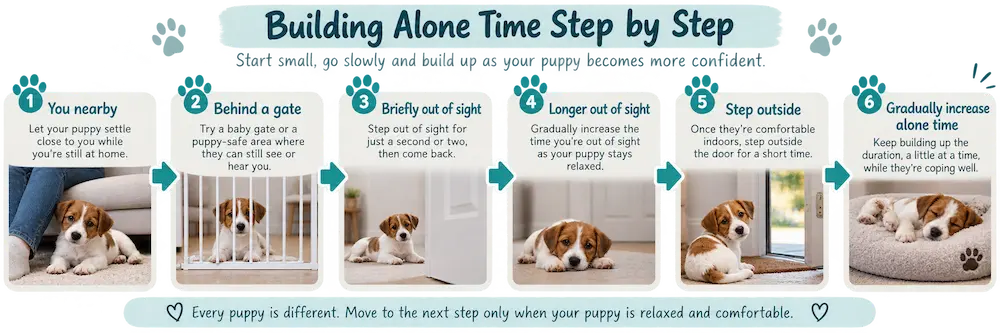
Step 1: Practice Being Apart While You're Still Home
Start somewhere easy. Have your puppy settle a short distance from you, perhaps behind a baby gate or in a comfortable puppy-safe area where they can still see or hear you.
Once they’re relaxed with that, briefly step out of sight. At first, you might disappear for only a second or two before coming back.
Repeat this at different times rather than trying to make every attempt longer than the last. When your puppy is consistently comfortable, gradually increase the time you’re out of sight.
If they start whining, pacing or struggling to settle, that’s useful information: the exercise has become too difficult. Shorten the next separation to something they can manage.
Step 2: Make Your Leaving Cues Less Important
Some puppies start getting anxious before you’ve even reached the door. Picking up your keys, putting on your shoes or grabbing your coat can all become signals that you’re about to leave.
You can help make those signals less meaningful by doing them at times when you’re not going anywhere.
Pick up your keys and put them down again. Put on your shoes, then make a cup of coffee. Grab your coat and sit down for a few minutes. Mix things up so those everyday actions don’t always predict that you’re about to disappear.
Keep these little practice sessions relaxed and uneventful. The aim isn’t to trick your puppy—it’s to help them learn that the sight of your keys or coat doesn’t always mean they’re about to be left alone.
Step 3: Start Stepping Outside
Once your puppy can cope comfortably with you being out of sight indoors, start practising very short departures through the door.
At first, step outside for just a second or two and come straight back in. If your puppy remains relaxed, repeat the exercise and gradually build up the time.
Don’t feel that every attempt has to be longer. Mixing in some easier, shorter absences can help keep the exercise manageable.
Most importantly, let your puppy’s behaviour guide you. If they’re becoming worried, shorten the absence rather than pushing ahead simply because you’ve reached a particular number of minutes.
Step 4: Set Your Puppy Up for a Calm Departure
Before you leave your puppy alone, give them a chance to go to the toilet and spend a little time playing, walking or exploring with you. A puppy who’s bursting with energy—or desperately needs a pee—is going to find settling down much harder.
Choose a comfortable, puppy-safe place for them to relax and leave something appropriate to chew or play with if they enjoy that.
A stuffed food toy can be useful too, but don’t worry if a puppy who’s genuinely anxious won’t touch it. When a dog is very distressed, even something they normally love may suddenly seem uninteresting.
Try to keep leaving and coming home fairly low-key as well. You don’t need to sneak out, but neither does every departure need a five-minute goodbye.
What if my puppy won’t eat their treat?
If your puppy normally loves a particular treat or food toy but won’t touch it when you leave, don’t assume you need a tastier treat. It may be a sign that the situation has become too difficult for them.
Go back to an easier stage where your puppy is comfortable and build up more gradually.
What About Crate Training?
A crate can be a comfortable, familiar place for a puppy who has been introduced to it gradually and genuinely enjoys resting there. For some puppies, it can be a useful part of learning to spend time away from you.
If your puppy is new to a crate, start with crate training your puppy so they can learn to see it as a comfortable place before you use it for alone-time practice.
But a crate isn’t a treatment for separation anxiety.
If your puppy becomes more distressed when the crate door is closed—barking frantically, trying desperately to escape or hurting themselves trying to get out—don’t assume they just need to “get used to it.”
In that situation, a puppy-proofed room or safely enclosed area may be a better option while you work on their alone-time training.
The important thing is how your puppy feels in the space, not whether that space happens to be a crate.
Already happy in their crate?
Great. There’s no reason you can’t use it for appropriate periods while practising alone time.
But if being confined makes your puppy panic, repeatedly shutting them in and leaving them to cry isn’t going to teach them that being alone is safe.
What Not to Do When Your Puppy Struggles Alone
Coming home to a shredded cushion or listening to your puppy howl as you close the door can be incredibly frustrating. But if your puppy is genuinely distressed, punishment won’t teach them how to feel safer when they’re alone.
Don’t punish them when you get home. Your puppy isn’t chewing, toileting or barking to get back at you for leaving. Telling them off afterwards won’t help them understand what you wanted them to do instead—and may add more stress to an already difficult situation.
Avoid anti-bark devices or other methods designed to punish or startle your puppy into being quiet. The goal is to reduce the distress causing the barking, not simply suppress the noise.
Don’t use a “cry it out” approach for a puppy who’s panicking. A little puppy protest isn’t necessarily separation anxiety, as we talked about earlier. But if your puppy’s distress is escalating rather than settling, repeatedly leaving them in that state isn’t the gradual training we’re aiming for.
Don’t increase the time too quickly. Progress isn’t always a straight line. If your puppy managed five minutes yesterday but is struggling today, make today’s exercise easier. You’re building confidence, not trying to beat the clock.
Don’t rely on toys to fix genuine anxiety. Chews, food toys and enrichment can make alone time more pleasant, but they aren’t a substitute for gradual training when a puppy is frightened by being left.
If you’ve been following a consistent routine and you’re still dealing with repeated accidents or something just doesn’t seem to be clicking, that’s a little different. I’ve put together separate advice on what to do when puppy house training isn’t working, including common problems and how to get things back on track
Had a bad day? You haven’t ruined the training.
If you misjudged an absence and your puppy became distressed, simply use that information for the next session. Go back to a duration they can comfortably manage and build from there.
Teach Your Puppy That Being Alone Is Normal
Even if you work from home or spend most of the day with your puppy, it’s worth helping them learn that they don’t need to be beside you every minute.
Build little periods of independence into everyday life. Your puppy might relax in their bed while you move around the house, spend a short time behind a baby gate while you’re nearby, or enjoy something to chew while you get on with something in another room.
These aren’t big training sessions. They’re simply opportunities for your puppy to discover that being apart from you for a while is safe and normal—and that you coming and going is nothing to worry about.
Start while they’re comfortable and keep it easy. Those tiny separations can gradually become the foundation for the longer absences you’ve been practising.
There will be times when real life requires you to be away for longer than your puppy can currently manage in training.
If possible, arrange for a family member, friend, pet sitter or dog walker to help rather than repeatedly leaving your puppy for longer than they’re ready to cope with.
When to Ask Your Vet for Help
Some puppies just need time and plenty of gentle practice to learn that being alone is okay. But if your puppy is becoming extremely distressed, don’t feel that you have to solve it by yourself.
Talk to your vet if your puppy:
- Panics even during very short absences
- Frantically tries to escape or hurts themselves in the process
- Can’t settle or becomes increasingly distressed while you’re away
- Suddenly develops separation-related behaviour that wasn’t there before
- Isn’t making progress despite careful, gradual training
Your vet can also check whether there could be a medical issue contributing to a change in behaviour and, if necessary, recommend appropriate behavioural support. More serious cases may benefit from help from a veterinary behaviourist.
If you’ve been recording your puppy while you’re out, take some of those videos with you. Seeing exactly what happens before and after you leave can give your vet much more useful information than simply saying, “He destroys things when I’m gone.” Current AAHA guidance specifically recommends video recordings as a useful part of assessing separation problems.
Don’t wait for your puppy to hurt themselves
Frantic escape attempts can cause injuries, particularly if a frightened puppy is trying to force their way out of a crate, through a door or past another barrier. If your puppy is putting themselves at risk, get veterinary advice rather than continuing to increase their alone time.
Can medication help?
For some dogs with significant separation anxiety, a veterinarian may recommend medication alongside a behaviour modification plan. That’s a decision to make with your vet based on your individual dog—not something I’d try to guide readers through on this page.
That is enough. No drug names, dosages, supplements or “natural versus medication” recommendations. It gives readers the information they need while keeping DCK firmly on the appropriate side of veterinary advice.
Helping Your Puppy Feel Safe When You're Away
Teaching a puppy to be comfortable alone doesn’t happen overnight. Some puppies take to it quite easily; others need much smaller steps and a lot more patience.
Start with what your puppy can comfortably manage today and build from there. A few relaxed seconds are more useful than ten stressful minutes, and having to make an exercise easier doesn’t mean you’ve gone backwards.
Most importantly, pay attention to the puppy in front of you. If they’re coping well, you can gradually move forward. If they’re struggling, slow things down. And if their distress is severe or you’re simply not sure how to help, there’s nothing wrong with asking your vet or a qualified behaviour professional for guidance.
With time, patience and plenty of successful little separations, you’re helping your puppy learn one very important lesson: you can go away—and they can be okay until you come back.
More puppy help: Visit our Puppy Information guide for advice on training, behavior, health and caring for your new puppy.